Indian weddings in 2026 are putting guest experience and storytelling at the centre, and the Indian wedding photo booth has quietly become one of the most powerful places to show that shift. Instead of another neon hashtag wall with plastic props, couples now want corners that feel intentional, culturally rooted and genuinely fun to hang out in—not just five‑second selfie stops.[1][3]
1. How Indian weddings in 2026 are changing (and what that means for photo booths)
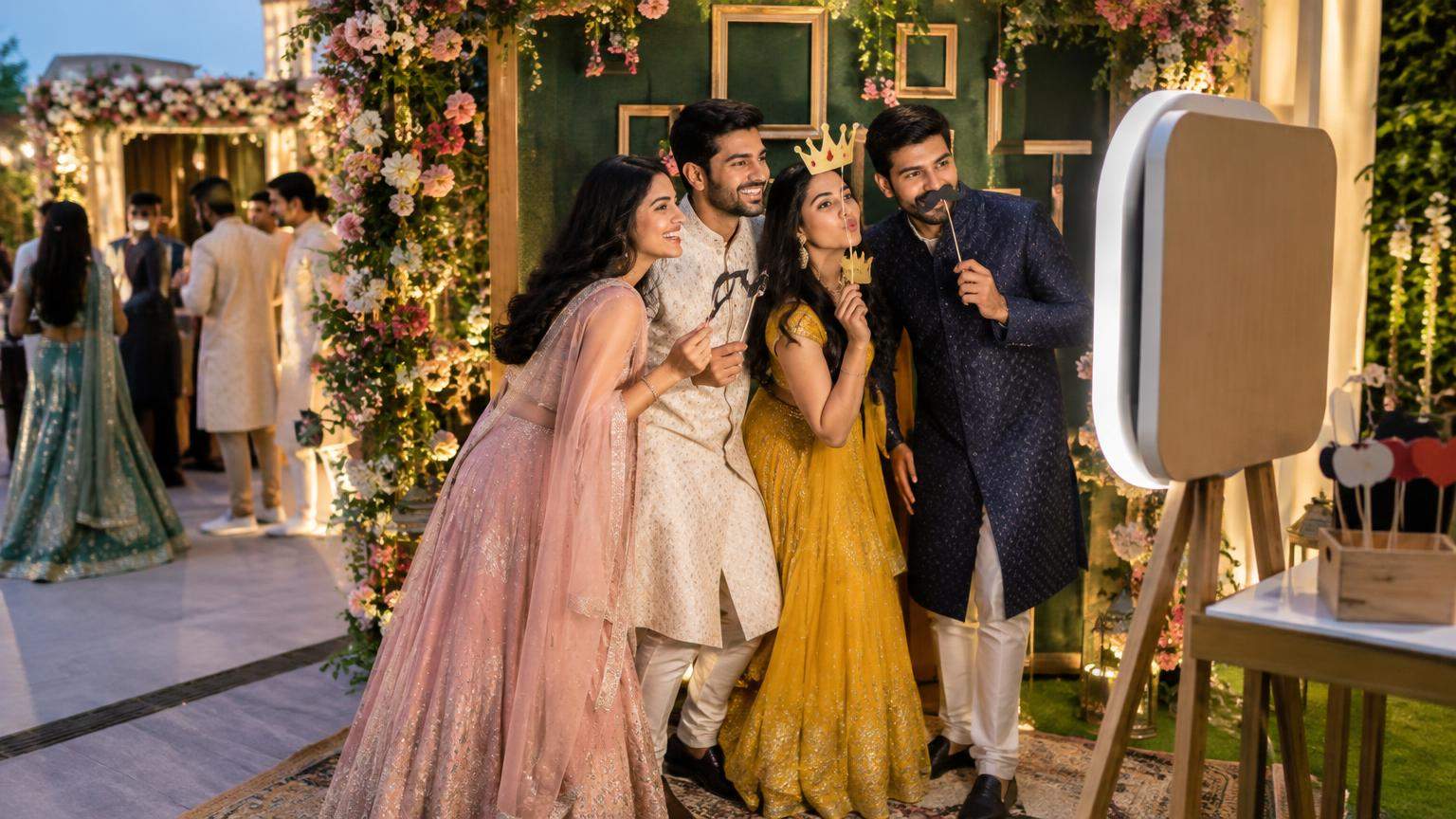
Indian wedding photography and decor trends for 2025–26 point to a clear pattern: less emphasis on sheer scale, more on meaningful, immersive experiences.[1][2]
Planners and photographers describe three big shifts:
- Experiences over spectacle: Many couples still invite huge guest lists, but they are choosier about where they spend. They are cutting generic add‑ons and investing in corners that feel personal—lounges, interactive stations and well‑designed photo areas that tell a story.[1]
- Storytelling over stiff posing: Photography studios in India report that couples want more candid, emotion‑driven coverage and less “just stand and smile at the stage.”[1][2] A creative booth can capture those relaxed interactions guests rarely show on stage.
- Interactive corners, not just backdrops: Indian planners now talk about “photo booths and interactive corners” together—spaces where guests can sit, chat, play a small game or use props, with good light for photos.[3]
For photo booths, this means that a single flat wall (neon sign + leaves + random props) is no longer enough. To feel current in 2026, the booth should function as a micro‑experience inside the wedding: somewhere people naturally drift to, stay for a bit and leave with photos that feel specific to your wedding.
2. What couples now expect from a booth at mehendi, sangeet and reception
Sources from Indian planners and international vendors who specialise in desi weddings agree that couples expect more than a generic backdrop, especially across multi‑day functions.[3][4][5]
2.1 Core expectations in 2026
From recent articles and client feedback, these expectations come up repeatedly:
- Something to do, not just somewhere to stand: Wedding guides emphasise that the booth should help break the ice, entertain guests and keep energy high—especially at mehendi and sangeet.[4] That might mean interactive props, a game, a swing, or a fun prompt.
- Insta‑worthy without feeling try‑hard: Couples still want strong visuals for Instagram and Reels, but they want those visuals to match the decor and rituals of each event instead of feeling copied from another wedding.[1][4]
- Space for groups and families: Vendors working desi weddings highlight the demand for group‑friendly setups and broader framing so multiple cousins or entire friend gangs can fit in comfortably.[5]
- Hybrid outputs: prints + digital: Guests consistently appreciate instant prints to take home, while couples want digital files that are easy to share online or via phone.[4][5][6]
2.2 Matching the booth to each function
Designing one look for the entire wedding often leads to visual fatigue. Instead, give each event a distinct but connected booth identity.
- Mehendi: Daytime, playful, colourful. Think shaded seating, low diwans, hand fans or parasols, and a backdrop that echoes henna motifs or regional textiles rather than standard tassel curtains. This also becomes a comfortable corner for elders between mehendi turns.[3][4]
- Sangeet: High‑energy and performance‑driven. Here, a booth that picks up the stage lighting, mirror details, or Bollywood references works well. Consider something guests can interact with between performances—like a mock mic stand, dhol props, or a dance‑floor‑adjacent “green room” booth.
- Reception: More formal and polished. Use cleaner lines, subtle florals or metallics, and a layout that doubles as a family‑portrait spot so relatives can get stage‑level photos in a less rushed environment.
Guests on wedding forums often mention that they remember weddings where a booth was present at multiple events, with slightly different looks.[6] You don’t need to build three huge sets; re‑use structure and lighting, then change fabrics, props and signage to suit each function.
3. Trends guests are tired of (and what to do instead)
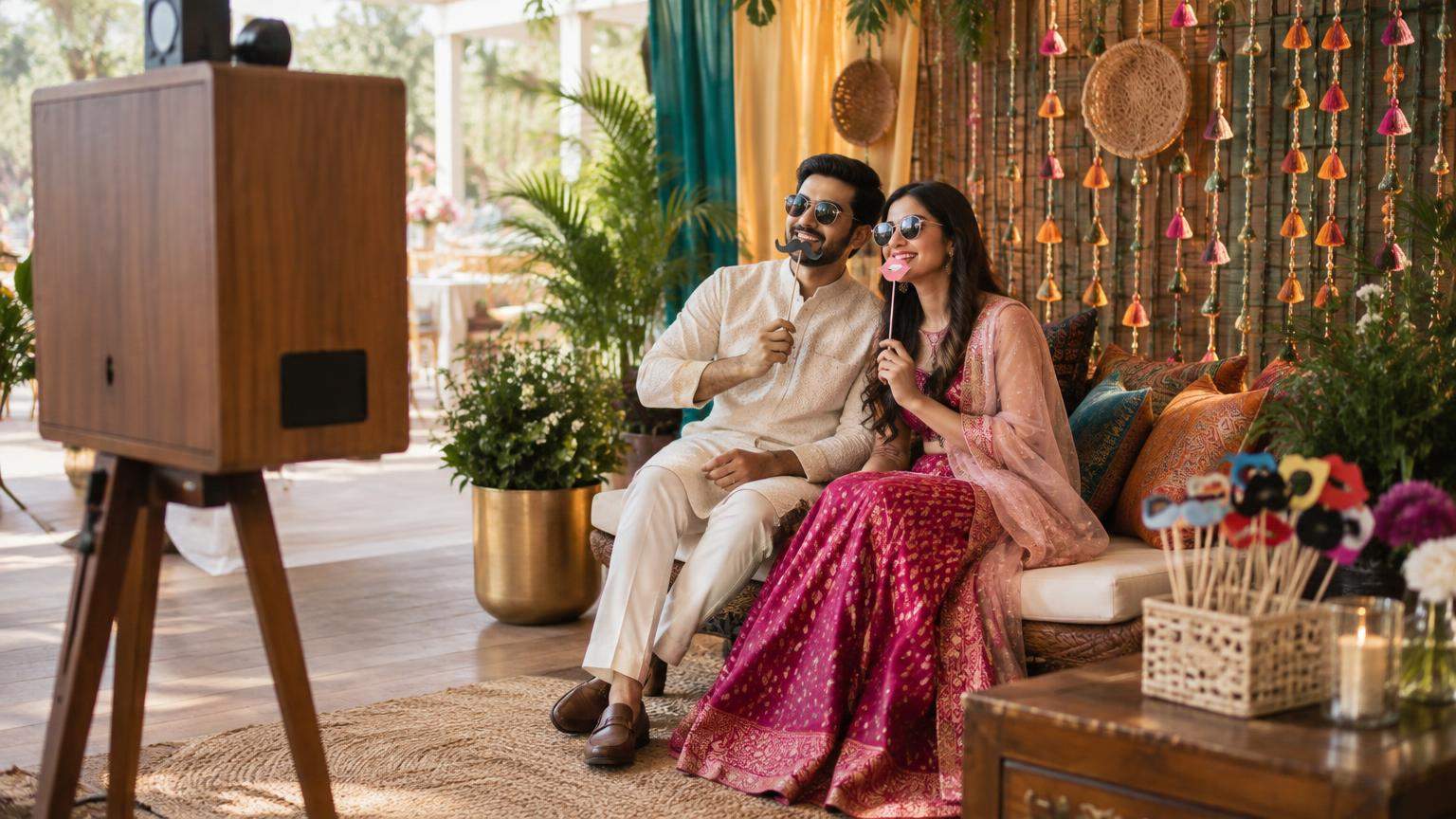
Online desi wedding communities are increasingly blunt about trends they feel have been “done to death.”[6][7]
3.1 Ideas that feel overdone in 2026
Based on recent discussions and mainstream decor round‑ups, these elements often get called out as stale:
- Neon hashtag walls as the only booth: A neon sign plus artificial foliage was aspirational a few years ago. Now, guests joke about seeing the same set‑up at every other wedding.[7][8]
- Generic moustache / oversize sunglasses props: They rarely match the couple’s personality or the event’s cultural vibe; they just clutter pictures.
- Copy‑paste floral frames: Endless marigold strings or paper‑flower rectangles, with nothing that actually references the couple or their story.[9]
- Trends that erase regional identity: Commenters increasingly push back against decor that could be anywhere in the world, with no nod to the couple’s community, language or rituals.[7]
That doesn’t mean you can’t use neon, florals or props at all—it means they shouldn’t be the whole concept. You’ll get better reactions by using them in a way that feels specific and intentional.
3.2 Fresh alternatives to overused ideas
Here’s a quick comparison to guide decisions with your planner or booth vendor:
| Overdone element | Why it falls flat in 2026 | Fresher alternative concept |
|---|---|---|
| Single neon hashtag on greenery wall | Looks identical across weddings; little cultural or personal meaning.[7][8] | Story‑based signboard (“How we met”, “Team bride/groom choices”) with regional motifs, or a neon phrase in your own language framed by textiles or folk art. |
| Random moustache / glasses props | Do not relate to the couple or event; clutter photos. | Minimal, intentional props: e.g., miniature dhols, fans with inside jokes, placards with local slang, or bangles and pagris that guests will genuinely wear. |
| Flat marigold frame | Pretty but predictable; no sense of depth or experience.[9] | Layered floral arch with a jhoola, charpai or bench so people can sit, chat and be photographed naturally.[3][9] |
| One stand‑alone booth in a corner | Feels like an add‑on; often ignored when the dance floor gets busy. | Two or three smaller “photo corners” near bar, lounge or entry, each loosely tied to the theme, so guests keep encountering them through the night.[3] |
4. Region‑sensitive concepts without stereotypes
Indian weddings vary widely even within the same state, so there is no universal design formula. But recent idea round‑ups encourage couples to draw inspiration from regional textiles, art and rituals rather than only Western or generic themes.[10]
Below are broad, flexible concepts you can adapt with your decorator. Treat them as starting points, not rules.
4.1 Punjabi‑inspired ideas
- Phulkari & truck‑art wall: Use phulkari‑patterned fabrics, bright borders and playful truck‑art typography for signs (“Balle Balle Booth”, “Pataka Dulhan”).
- Dhol station: A low platform with real dhols and colourful chadar backdrops where guests can hold or pretend to play instruments—great for sangeet.
- Old‑school pind courtyard: Mud‑style painted wall, charpais, brass lotas and lanterns for a cosy mehendi corner.
4.2 South‑Indian‑inspired ideas
- Temple gopuram silhouette: A stylised temple outline as the frame, with strings of jasmine and banana leaves.
- Kanjivaram details: Backdrop panels with saree border motifs in gold, maroon or green, paired with traditional lamps.
- Filter coffee adda: A staged “coffee stall” with tumblers, brass elements and a seating nook where guests can actually sip coffee or mocktails while being photographed.
4.3 Bengali‑inspired ideas
- Alpona floor art: Hand‑drawn white alpona patterns on the floor or backdrop panels, with red‑white accents.
- Shola and conch details: Motifs inspired by shola headgear and conch shells, arranged subtly so nothing feels costume‑like.
- Adda corner: A simple bench or parapet‑style seat with books, tea glasses and nostalgic Kolkata posters for candid “adda” photos.
4.4 Gujarati‑inspired ideas
- Bandhani and mirror work: Patchwork of bandhani fabrics and small mirror details for vibrant, textured backdrops.[10]
- Garba silhouettes: Backlit cut‑outs of dancing figures, or a faux “raas floor” corner with dandiya sticks as props.
- Pol courtyard vibe: Arched windows, latticed jharokhas and pastel walls referencing old city homes.
When you plan these concepts, keep checking: Does this feel respectful and recognisable to our families, or like a costume? Lean on patterns, colours and everyday objects rather than caricatures.
5. Designing immersive sets on a realistic budget
Planner portfolios in India show that standout booths often rely on one strong idea plus thoughtful styling, rather than sheer expenditure.[3][9]
5.1 Use what the decor team is already building
Many Indian planners describe their photo booths as extensions of the main decor.[3] This saves money and keeps the venue cohesive.
Practical ways to do this:
- Borrow the hero element: If the stage has a floral arch, repeat a simplified arch at the booth. If the mandap has carved pillars, use similar shapes with fabric or MDF for the booth.
- Reuse florals and fabrics: Ask your planner whether some florals from ceremony areas can be moved to the photo corner later in the event, or whether offcuts of drapes can be used to build textile panels.
- Share lighting and tech: Often the DJ or lighting team can rig an extra softbox, fairy‑light curtain or spotlight for the booth without major extra cost.
5.2 Prioritise depth, seating and light over expensive props
Indian decor articles emphasise simple structures: frames, swings, arches and layered drapes, elevated by clever floral or textile work.[3][9]
Focus your budget on:
- Depth: Use at least three layers: the far backdrop (wall or fabric), a mid‑layer (arches, strings, hanging elements) and a foreground (seating or small table). This makes even phone photos look richer.
- Comfortable seating: A well‑cushioned jhoola, bench or charpai encourages elders and kids to sit, relax and naturally pose—much easier than herding everyone onto a tight standing mark.[3]
- Flattering lighting: Warm, even lighting beats the most expensive backdrop. Ask your photographer or booth vendor what kind of continuous lights they recommend so faces don’t look harsh or shadowed.
5.3 Low‑cost interactive ideas
Wedding idea sites show that some of the most memorable booths depend more on concept than construction.[4]
A few adaptable, budget‑friendly formats:
- Before vs After corner: Two mini‑sets side by side—“before shaadi” vs “after shaadi”, or “bride’s city” vs “groom’s city.” Simple printed backdrops and a couple of props can carry the joke.[4]
- Message wall: Guests write wishes or marriage advice on cards, which double as a textured backdrop.
- Prompt cards: A stand with small prompt boards: “Show us your go‑to shaadi dance step”, “Pose like a Bollywood villain”, “Recreate our first date photo.” Cheap to produce, big on fun.
6. Integrating AI or AR without killing traditional charm
Indian photography studios are increasingly clear that AI is a tool to support good images, not a replacement for them.[1][2]
6.1 Where AI already fits naturally
Recent trends articles highlight several backstage uses of AI in wedding photography:[1][2]
- Fast culling and sorting: Algorithms help photographers filter thousands of images so couples receive the best shots more quickly.
- Subtle enhancement: Colour grading, gentle retouching and exposure corrections done with AI can give a consistent, cinematic feel without looking artificial, when used carefully.
Hiring a booth vendor or photographer who uses these tools well can improve turnaround time and consistency—without changing what guests experience on the day.
6.2 Light‑touch AR and AI at the booth itself
Some wedding idea platforms now suggest playful AI/AR concepts, like a face‑swap or themed filter booth.[4] If you’re considering them, keep these guardrails:
- Keep it optional: Offer one station with digital effects and another with clean, classic photos so elders and traditionalists aren’t forced into filters.
- Match the theme: If you use AR, tie it to your motifs: for example, subtle animated confetti in your wedding colours, or an outline of your city’s skyline—not random cartoon ears.
- Avoid heavy beautification filters: Over‑smoothing or changing facial features can feel disrespectful and may age badly in albums.
If in doubt, let AI stay in the backend for editing, and keep the visible part of the booth simple, well‑lit and timeless.
7. Guest flow planning for 800+ guest lists
Indian receptions are famous for long stage queues. Many couples now try to reduce that fatigue by creating alternative, more relaxed photo spots.[3][6]
There’s limited formal research on booth flow, but planners and guests give enough hints to draw some practical guidelines.
To keep the photo booth experience enjoyable for everyone, check out our guide to photo booth etiquette and guest-friendly event practices, including queue management, props and group photography.
7.1 Placement that keeps things moving
- Away from the main stage line: Place the booth where guests can peel off naturally—near the bar, lounge seating or snack stations—but not blocking entrances or service paths.[3]
- Clear entry and exit: Use carpet runners, ropes or simple signboards to show where to queue and where to step out, so groups aren’t bumping into each other.
- Enough space for groups: In big fat Indian weddings, assume groups of 6–10 at a time. Design at least that much standing or seating room in front of the camera.
7.2 Special care for elders and kids
- Seating at the booth: A sturdy bench with armrests or a low sofa allows elders to sit comfortably for photos.
- Attendant support: Ensure the booth staff are briefed to help elders step onto the set safely, adjust dupattas or pagris if needed, and manage the queue gently.
- Kid‑friendly timing: Open the booth early in the event, before children get tired. Consider a small step or box for kids so they’re visible in group shots.
7.3 Consider multiple mini‑corners
Discussion threads show guests appreciating when photo opportunities pop up across different events or areas, not just once.[6] For very large weddings, you can:
- Set up one main booth for portraits, and
- Add one or two small, decor‑only corners where guests can take their own selfies.
This spreads out traffic and ensures more people get good photos without queuing for half the evening.
8. How to pitch fresh booth ideas to parents and planners who want “safe” options
Many couples find themselves negotiating between their own Pinterest boards and their parents’ comfort zone. Wedding forums reflect a growing desire to keep authenticity while trimming excess and fads.[7]
Here’s how to present fresh booth concepts so they feel reassuring, not risky.
8.1 Use language elders care about
Frame your proposal in terms that matter to parents:
- Respect: Emphasise how the design honours your community—through motifs, colours or objects they recognise.
- Practicality: Explain that the booth doubles as a family photo corner, so relatives get good pictures without waiting in long stage lines.
- Budget sense: Show how reusing stage decor or mandap elements keeps costs under control compared with building a separate, trendy installation.
8.2 Offer a familiar base with modern tweaks
Instead of suggesting something completely unknown:
- Start with a format elders already like (floral jhoola, arch, mandap‑style pillars).
- Then layer in modern touches: cleaner typography, personalised prompts, or subtle lighting effects instead of loud gimmicks.
This way the booth looks current to you and “proper” to them.
8.3 Show references that look Indian, not imported
When sharing moodboards with planners or family, prioritise examples from Indian weddings—especially those that incorporate cultural elements in a modern way.[3][10] It’s easier to sell a new idea when everyone can see that it has already worked in a similar context.
9. Deliverables that matter in 2026: prints, QR galleries and phones
Vendors working with Indian diaspora weddings and local decor guides all highlight that guests want physical keepsakes and easy sharing options.[4][5][6]
9.1 Instant prints are still loved
Photo booth companies note that couples consistently request instant prints as favours at Indian weddings, and guests remember booths that gave them personalised strips or postcards.[5][6]
To keep prints useful later:
- Use a clean layout with the couple’s names, date and maybe a small motif—not a giant logo.
- Offer at least one classic format (4×6 or postcard) guests can frame.
- Consider one design per event (mehendi, sangeet, reception) rather than one generic template for everything.
9.2 Digital delivery that actually gets used
Many modern booths now combine prints with digital files via:
- Online galleries or micro‑sites: Guests scan a QR code at the booth to access their photos later.[4][5]
- Email or SMS sharing: Handy for out‑of‑town guests and for couples who want their own email list.
In India, WhatsApp is widely used for sharing event photos, so it’s common for couples or vendors to circulate gallery links through family groups and friends’ circles. This is not tracked formally, but it is a practical reality in many weddings.
9.3 Set expectations in advance
Ask your booth vendor to clarify:
- How long they will host the online gallery.
- Whether guests can download full‑resolution files.
- How many print copies per session are included.
Sharing this information with guests (on a small sign at the booth) reduces confusion and follow‑up messages later.
10. Real‑world booth concepts from 2025–26 weddings
Indian planner portfolios and wedding portals share recent examples that illustrate how the trends above work in practice.[3][4]
- Interactive mehendi corner: One planner showcases a mehendi space with low diwans, colourful umbrellas above, and a simple printed backdrop. The area doubles as a hangout zone and a photo corner, so it stays lively even when guests are not actively posing.[3]
- Sequin‑and‑swing sangeet booth: Another portfolio shows a metallic sequin backdrop with a floral swing in front, lit well enough for both phone and professional cameras. The swing gives guests something to do and naturally staggers the queue.[3]
- Concept‑driven “before vs after” booth: A 2026 idea list features a split set—two contrasting mini‑rooms that playfully represent life pre‑ and post‑marriage—with simple furniture and clever signboards carrying the concept.[4]
- Magazine‑style frames and covers: Some vendors highlight large frame structures designed like magazine covers or posters that guests stand inside, creating clean, graphic photos. These work especially well at cocktail or reception nights where guests are dressed formally.[4]
These examples share a pattern: each booth has a clear concept, integrates with the broader decor, and gives guests a small action (sit, swing, compare, play) rather than just a blank wall.
Frequently Asked Questions
How much space do we really need for an Indian wedding photo booth?
For group‑friendly photos and comfortable movement, aim for at least 10–12 feet of width and 8–10 feet of depth, plus some queuing space. Larger guest lists or elaborate sets may need more. Your decorator and venue can help you mark this out on the floor plan.
Should we skip the stage if we have a great photo booth?
Most Indian families still expect a stage or main seating area for formal introductions and rituals. Instead of skipping it, you can reduce the time spent on staged photos and encourage relatives to visit the booth later for relaxed group portraits.
Is a 360‑degree or video booth worth it for Indian weddings?
It depends on your crowd. Younger guests may love a 360 or slow‑motion video booth, especially at sangeet or cocktail nights. Elders and shy guests often prefer simpler, seated photo corners. If budget allows, one interactive video booth plus one classic photo booth covers both preferences.
How do we ensure elders use and enjoy the booth?
Provide comfortable seating, gentle lighting, and at least one attendant who can guide them. Choose culturally familiar decor so they feel proud, not self‑conscious. Schedule some time when cousins can intentionally bring grandparents and older relatives to the booth between ceremonies.
What’s the ideal number of props?
Prioritise quality over quantity. A handful of thoughtful, sturdy props that match your concept (for example, traditional umbrellas, dhols, fans, minimal signboards) photograph better and last longer than a big pile of random plastic accessories.
Practical takeaways
- Treat the Indian wedding photo booth as an experiential corner where guests can relax, not just a backdrop.
- Retire the one‑note neon hashtag wall as your only idea; personalise with regional motifs, stories and interactive elements instead.[7]
- Reuse decor, focus on seating and lighting, and build depth to keep budgets sensible.[3][9]
- Offer both instant prints and easy digital access; set clear expectations about delivery.[4][5]
- Use AI mostly as a behind‑the‑scenes tool, and keep visible filters subtle so your photos age well.[1][2]
A well‑thought‑out booth will outlast any trending prop: years from now, your guests will still smile at photos that show them comfortable, seen and having genuine fun.
Disclaimer
This article provides general design and planning guidance for Indian wedding photo booths based on publicly available sources and observed trends as of 2025–26.[1][3][4] Availability of specific services, technologies and styles can vary by region and vendor. Always confirm details, costs and feasibility with your own planner, photographer, venue and photo booth provider before finalising decisions.
Sources and Further Reading
Primary and supporting references. Verify time-sensitive information at the original publisher.
- Indian Wedding Photography Trends 2026 — wedhues.in
- Wedding Photography Trends India 2025 2026 — www.weddingclickz.com
- Photo Booths Interactive Corners — mytribe.in
- Wedding Photo Booth Ideas — destinationweddingbharat.com
- Indian Wedding Photo Booth Ideas Nyc — clickandjoypb.com
- 1mzxppk — www.reddit.com
- 1iwlsj1 — www.reddit.com
- Pin Worthy Photo Booths For The Wedding Season — www.weddingplz.com
- Floral Photo Booth Ideas For Indian Weddings — threads.werindia.com
- Best Photo Booth Ideas For Indian Wedding 2025 — www.makemyinvite.com
Research date: October 17, 2026 (UTC). Links may change.