Event planners comparing Glambot vs 360 photo booth options in 2026 are really choosing between two quite different video experiences: a cinematic, robotic camera “hero shot” and an energetic, social‑media‑friendly spin video. Understanding how each works, what they demand from your venue and budget, and how guests actually interact with them will help you pick the right fit rather than the trendiest label.
What Exactly Is Being Compared?

Glambot and 360 photo booths both produce short, shareable video clips, often in slow motion, but they achieve this in very different ways.
- Glambot-style robotic camera experiences use a cinema or mirrorless camera mounted on a high‑speed programmable robotic arm. Companies such as Red Carpet Robot describe this as a “robotic camera experience” that turns a short guest performance into a cinematic slow‑motion clip using repeatable robotic camera moves and high‑speed capture. [1] [2] Vendors often use motion‑control systems like the Bolt Jr+ originally designed for film and VFX work. [3]
- 360 photo booths place guests on or around a platform while a motorised arm with a camera or smartphone rotates around them in a circle, capturing a brief video that is later slowed down and stylised with effects. Guides from specialist providers explain that the rotating arm, not the guests, creates the 360 effect, and that clips are optimised for instant social‑media sharing. [4] [5]
Both are visually striking, but the robotic arm versus orbiting camera arm leads to big differences in safety zones, staffing, production value and cost.
Definitions and Assumptions for 2026
Because there is no single standard product for either category, it helps to define how this article uses the terms.
What Is a Glambot for Events?
For this comparison, a Glambot is any event activation that combines:
- a programmable robotic arm (often systems like the Bolt or Bolt Jr+),
- a cinema or high‑quality mirrorless camera, and
- pre‑planned camera moves plus guest direction to create dramatic slow‑motion clips.
Red Carpet Robot, for example, highlights three pillars of the experience: repeatable robotic movement, high‑speed capture, and clear direction so each guest “knows exactly what to do” in front of the camera. [2] To Be Production similarly promotes its GLAMBOT service as a motion‑control robotic camera system repurposed from film production for events. [3]
Historically, the “Glambot” name is linked to the robotic camera used on major award‑show red carpets to film slow‑motion celebrity entrances, operated by director Cole Walliser and others. [6] Over time, event companies have adapted the concept for brand activations, premieres and high‑budget private events.
Important caveats
- “Glambot” is partly a format and marketing term, not a single device. Different vendors use different robots, cameras and software.
- Frame rates, safety systems and exact physical footprints vary; do not assume every Glambot offers the same specifications as the ones used on award shows.
- Complex robotics require trained operators and careful risk management, which directly affects cost and feasibility.
What Is a 360 Photo Booth?
A 360 photo booth (often called a 360 video booth) is a compact system where:
- Guests stand on or near a circular platform in the middle.
- A motorised or manually spun arm with a camera rotates around them in a 360‑degree arc.
- Software converts the short recording into a slow‑motion or speed‑ramped clip with overlays, music and branding, then delivers it digitally for sharing. [4] [5]
Booth Empire’s technical guide, for instance, explains that the platform and rotating arm work together: the camera path is a fixed radius circle around the guest, and the resulting video is slowed down and enhanced with effects. [4] Other guides highlight that some systems use smartphones or action cameras, while higher‑end units may mount DSLRs or mirrorless cameras. [8] [9]
Important caveats
- Some 360 platforms are manual (the operator pushes the arm), while many modern units are motorised with remote‑controlled speeds and start/stop. User manuals describe variable speed settings and remote control functions. [7]
- Camera quality, stability, software and lighting setups differ widely between budget and premium 360 offerings.
- Safety, especially keeping bystanders clear of the spinning arm and respecting platform load limits, depends heavily on the specific hardware and operator training. [4] [7]
Feature‑by‑Feature Comparison
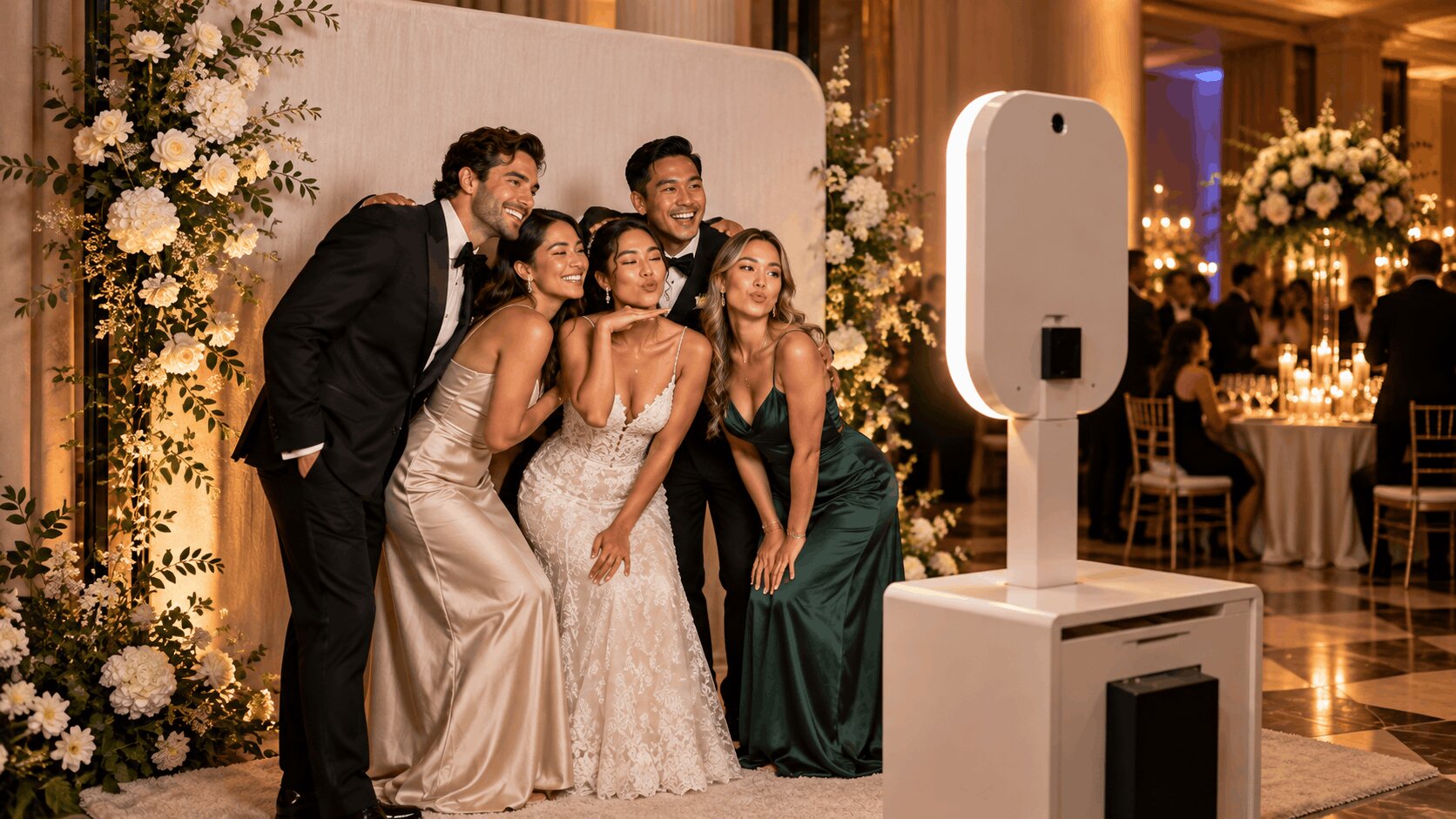
The table below summarises the most relevant technical and practical differences for event planners.
| Feature | Glambot‑style Robotic Camera | 360 Photo Booth |
|---|---|---|
| Core technology | High‑speed robotic arm (e.g., Bolt Jr+) moving a cinema/mirrorless camera through complex 3D paths. [2] [3] | Rotating arm with camera or phone moving in a horizontal circle around central platform. [4] |
| Camera movement | Programmable moves: push‑ins, arcs, sweeps, height changes and tilts in one shot. | Primarily circular orbit at fixed radius, with limited tilt; no complex 3D trajectories. |
| Video style | Cinematic, “hero” slow‑motion shots with dramatic camera motion, often echoing red‑carpet aesthetics. [1] [6] | Energetic spin videos emphasising fun, group interaction and social‑media‑ready effects. [4] [5] |
| Guest participation | Usually one person or small group at a time; requires direction to hit marks and perform for the camera. [2] | One to several guests on the platform; casual posing or dancing while the arm spins. |
| Operators & staffing | Specialised crew for robot operation, camera, safety and guest direction. [1] [3] | Typically one operator plus, optionally, an assistant for crowd management and sharing. [5] [9] |
| Safety zone & footprint | Requires a clear exclusion zone around robot; vendor examples show footprints from roughly 16′×16′ to 20′×24′ depending on robot size. [2] | Needs space for platform diameter plus perimeter around spinning arm; usually smaller than a full robotic rig, but still requires a cleared area. [4] |
| Lighting | Often uses dedicated beauty lighting setups (key/fill/backlight) for a polished, red‑carpet look. [1] | Commonly uses LED ring lights or small panels integrated into the rig or tripod to light faces evenly. [4] |
| Setup complexity | Heavier gear, more crew and longer load‑in/out; may need venue site visit and detailed planning. [1] [3] | Relatively quick to set up; many systems are designed for mobile event use with simplified power and cabling. [4] [9] |
| Throughput (guests per hour) | Typically lower, as each guest is coached and shots may be reviewed; best for curated VIP lists. [1] | Typically higher, with short clips and rapid turnover; suited to parties and busy activations. [5] [9] |
| Digital delivery & sharing | Short cinematic clips; delivery workflows vary (on‑site previews, post‑event galleries, or live displays). [1] [2] | Designed for instant sharing via QR codes, email, AirDrop or SMS, with overlays, intros/outros and brand assets. [4] [8] |
| Branding options | Branded graphics, intros/outros and logo treatments integrated into high‑end slow‑motion clips. [1] | Highly flexible overlays, frames, hashtags and sponsor branding within the sharing app and videos. [4] [8] |
| Typical use cases | Award‑show red carpets, premieres, VIP zones at brand launches, luxury weddings. [1] [6] | Weddings, birthday parties, corporate events, trade shows, brand activations and festivals. [4] [5] [9] |
| Budget level (qualitative) | Premium to very high, reflecting robotics, crew and logistics. [1] [3] | Entry‑level to mid‑range, with pricing influenced by equipment quality, event length and branding add‑ons. [5] [9] |
Technology, Setup and Guest Experience in Detail
Robotic Camera Movement vs Rotating Arm
Glambot robotic cameras rely on industrial motion‑control systems. Providers like To Be Production use a Bolt Jr+ arm capable of repeatable, high‑speed moves designed for precise camera paths in film production. [3] These arms move the camera through three‑dimensional space, so a shot can combine a fast push‑in, lateral move and tilt in a single pass.
For events, that translates into:
- Striking parallax as the background shifts relative to the guest.
- Dynamic perspective changes that feel “cinematic” rather than simply rotational.
- The ability to repeat a favourite move exactly for each guest, maintaining a consistent look. [2]
360 photo booths work differently. As Booth Empire explains, the camera is fixed to an arm that simply rotates around the central platform; the path is a horizontal circle with optional tilt adjustments. [4] The visual excitement comes from the sense of spinning around the guests and the slow‑motion or boomerang‑style effects added in software, not from complex 3D camera moves.
Video Style and Slow Motion
On a Glambot rig, the combination of fast camera movement and high frame‑rate recording creates that familiar red‑carpet slow‑motion look: hair flips, garment flows and small gestures become dramatic moments. Historical coverage suggests that award‑show Glambots sometimes record at extremely high frame rates with cinema cameras, then play back at standard speeds to produce very smooth slow motion. [6]
By contrast, 360 booths typically record for a few seconds as the arm spins, then software selectively slows down, speeds up or loops parts of the clip. Vendor guides describe workflows where the raw video (often 5–15 seconds) is transformed with speed ramps, reverse segments, overlays and pre‑licensed music into a short, shareable file. [4] [5]
Guest Participation and Direction
Glambot guests are often coached into specific moves that will read well on camera—twirls, outfit reveals, hair flips, confetti tosses and so on. Red Carpet Robot notes that the results depend heavily on clear direction so each participant understands what to do as the robot moves. [2] That means:
- Slightly more pressure on each guest to “perform”.
- More one‑on‑one time with a director or host.
- Fewer total guests cycling through, but more curated, high‑impact clips.
360 booth guests usually need only simple instructions: step on the platform, wait for the countdown and “have fun” while the arm spins. Guides from GTA Booth 360 and PicBooth emphasise casual use, group participation and quick turnover. [5] [9] This tends to:
- Lower the barrier to participation—anyone can jump in.
- Encourage groups of friends or colleagues.
- Generate many more clips across the event, with less individual coaching.
Safety Zones and Venue Space
Glambot setups require clearly defined safety zones. Red Carpet Robot’s planning guidance mentions example footprints such as approximately 16′×16′ for a smaller “Robot Jr.” configuration and larger spaces up to around 20′×24′ for bigger rigs. [2] That space must accommodate:
- Robot arm sweep plus camera and cabling.
- Lighting, control stations and monitors.
- Guest staging areas and queue lines.
Because high‑speed industrial arms can deliver significant force, professional operators will typically enforce exclusion zones, barriers or clear floor markings and strict rules about when guests may step onto the set. [1] (Exact safety procedures differ by vendor and jurisdiction.)
360 booths also need a dedicated footprint, but on a smaller scale. Booth Empire’s guide highlights the need for level flooring, space for the platform and a safe perimeter around the rotating arm so bystanders do not inadvertently step into its path. [4] User manuals for motorised 360 platforms emphasise weight limits, safe operating speeds and ensuring that only authorised guests step on or off while the arm is stopped. [7]
In practical terms, a 360 booth can often slot into the corner of a ballroom or foyer where a Glambot rig would be impractical.
Lighting Requirements
Both experiences benefit from strong, controlled lighting, but the expectations differ.
- Glambot lighting tends to mimic film or fashion shoots, with soft, flattering light and careful control of shadows and reflections—especially for red‑carpet style activations. Promotional materials from providers show substantial lighting rigs, suggesting a more involved lighting design than typical party booths. [1]
- 360 booths often incorporate LED ring lights or compact LED panels around the camera or on separate stands. Booth Empire and similar guides show examples where integrated ring lighting provides even illumination for faces. [4]
For darker venues, both systems may need additional lighting; however, Glambot installations are more likely to demand a dedicated lighting design session, while many 360 booths are designed to work acceptably with a simpler kit.
Throughput and Guest Flow
No vendor publishes universal throughput figures, and actual numbers depend on clip length, guest coaching and technical workflow. That said, vendor positioning suggests distinct tendencies:
- Glambot is geared toward impact over volume. Red‑carpet style activations focus on VIPs, influencers or selected guests who each receive a carefully composed hero shot, often with playback and retakes. [1]
- 360 booths are marketed for parties and corporate functions where many guests can cycle through, generating a large number of clips. Guides stress realistic expectations and mention that discpline around queueing and clip length helps manage lines. [5] [9]
For an all‑hands staff party or public activation, a 360 system will usually serve more guests than a Glambot in the same time window.
Digital Delivery and Branding
Glambot clips can be delivered in several ways depending on the vendor:
- On‑site playback on monitors or LED walls to create a live spectacle. [1]
- Delivery to guests during or after the event, often via links or shared galleries.
- Integration of brand elements such as logo intros, lower‑thirds or end slates. [1] [2]
360 photo booths lean heavily on instant, self‑service delivery. Booth Lab, for instance, markets 360‑compatible software that supports QR codes, email, SMS and AirDrop directly at the booth, plus sophisticated overlays and branded microsites. [8] This rapid workflow is a major advantage when the goal is social‑media reach during the event itself.
Use Cases: When Each Option Makes Sense
Different events call for different balances of spectacle, throughput, space and budget. Here is how Glambot vs 360 photo booth experiences typically fit into common 2026 event scenarios.
Weddings
Vendors specialising in 360 booths commonly promote them for weddings because they are compact, relatively quick to set up, and can entertain many guests throughout the evening. [5] [9]
- Best fit for most weddings: 360 photo booth
- Lively, group‑friendly clips of friends and family.
- Good balance between footprint and entertainment value.
- Easy customisation with the couple’s monogram, wedding hashtag and colour palette. [5]
- High‑budget or luxury weddings: Glambot as a feature moment
- Red‑carpet style shots of the couple and VIP guests.
- Possible use as part of the entrance or during a dedicated photo hour.
- Higher logistical complexity and cost, so often treated as a “wow” centrepiece rather than a roaming guest activity. [1]
For many couples, combining a 360 booth for general guests and a shorter Glambot activation for a handful of hero shots (budget permitting) can deliver both breadth and spectacle.
Red Carpets and Premieres
This is where Glambot is most strongly established. The term is widely associated with Hollywood award shows, where celebrities step into a carefully lit space, perform a brief motion and receive a glamorous slow‑motion playback. [6]
- Primary choice: Glambot
- Complementary option: 360 booth
- Ideal for after‑parties, fan zones or sponsor areas where higher throughput and casual fun are priorities.
- Excellent for branded overlays and sponsor logos on every clip. [10]
If you need one hero content station that screams “premiere night,” the Glambot is usually the more appropriate flagship experience, with 360 as an optional add‑on.
Brand Launches and Experiential Marketing
Both technologies are common at brand activations.
- Glambot for VIPs and campaign assets
- High‑end, cinematic clips for influencers, media and talent.
- Potential to repurpose content in campaign materials or highlight reels due to higher production value. [1]
- 360 booths for scale and engagement
A sensible structure is often: Glambot in the main stage or VIP area for curated content; one or more 360 booths in general‑access zones to engage the wider audience.
Corporate Functions and Conferences
Corporate clients frequently book 360 booths for awards nights, holiday parties and conference socials because the format is approachable and works with mixed age groups. [4] [9] The ability to instantly share branded videos also supports internal communications and employer‑branding goals.
Glambot, in this context, tends to suit:
- Flagship galas where the company wants a “celebrity” feel for top performers.
- Major product launches or anniversary celebrations with a strong PR component. [1]
For a standard annual party with a finite budget and a need to entertain hundreds of staff, a 360 booth is generally easier to justify than a full robotic camera rig.
Cost Drivers and Budget Planning
Vendors rarely publish one‑size‑fits‑all price lists, and costs vary by city, date and package. Still, the key cost drivers are clear.
Why Glambot Rigs Sit in a Higher Budget Tier
Glambot experiences typically involve:
- Specialised hardware (industrial robots, tracking systems, cinema cameras). [3]
- Skilled crew (robot operators, camera assistants, creative directors, safety supervisors). [1]
- Extended setup and teardown time, sometimes requiring access the day before or after a major event. [1]
- Planning, including potential site visits and custom motion programming. [2]
Providers such as Red Carpet Robot invite planners to request tailored quotes rather than listing package prices, underlining that costs are calculated case by case based on location, duration, robot size and creative brief. [1]
How 360 Photo Booth Pricing Is Typically Structured
Guides from 360 specialists describe more standardised packages, even though actual numbers differ by region. Common pricing variables include: [5] [9]
- Hire duration (e.g., 2, 3 or 4 hours on site).
- Day of week / peak dates (weekends and holidays may command higher rates).
- Equipment tier (phone vs professional camera, basic vs advanced lighting, size and capacity of platform). [9]
- Branding depth (simple logo overlay versus fully custom animations and microsites). [8]
- Travel and logistics (distance to venue, early load‑in, difficult access).
Many 360 vendors clearly advertise package tiers, reflecting a more repeatable setup and lower technical barriers than large robotic arms.
Budget‑Based Decision Guidelines
While avoiding specific prices, planners can use these general rules of thumb:
- If the experience is a headline attraction for a film premiere, luxury launch or televised gala, and budget and venue support complex installs, a Glambot can justify its premium bracket.
- If you need inclusive, high‑throughput engagement at a wedding, staff party or in‑store activation, a 360 booth is usually the more cost‑effective choice.
- In some campaigns, allocating budget to both—a Glambot for a few hours with key stakeholders and 360 for the broader audience—provides a layered experience.
Always ask vendors for a detailed breakdown of what is included so you can compare like with like.
If you are comparing event video booth packages and want to understand general rental costs, read our photo booth pricing guide. It covers different booth types and common package inclusions. Confirm current Glambot and 360 booth prices with individual vendors.
Risks, Limitations and Practical Trade‑offs
Safety Considerations
Glambot safety depends on professional handling of industrial robotics:
- Robots such as Bolt Jr+ are capable of rapid acceleration and significant force. Proper use requires trained operators, emergency stop procedures and clear exclusion zones. [3]
- Red Carpet Robot emphasises advance planning for space and guest flow, implicitly acknowledging the need for carefully controlled sets. [2]
- Venues may ask for method statements, risk assessments and proof of insurance; planners should expect and insist on these.
360 booth safety revolves around the spinning arm and platform:
- User manuals advise operators to control speed, respect load limits, and prevent guests from stepping on or off while the arm is moving. [7]
- Guides recommend a buffer zone so spectators cannot bump into the arm. [4]
- Slippery floors, high heels and intoxicated guests can increase risk, making supervision important.
In both cases, hiring reputable, insured vendors and following venue rules reduces risk significantly.
Technical Limitations
- Glambot limitations
- Not all venues have the ceiling height, floor loading or clear space needed for a robotic arm rig. [2]
- Setup times and costs make it less suitable for short or low‑budget bookings.
- The pre‑programmed nature of moves means creativity focuses on the guest’s performance rather than spontaneous camera experimentation, although operators can change moves between guests. [2]
- 360 booth limitations
- Camera movement is essentially limited to a circle; it cannot match the variety of cinematic paths possible with a robot arm. [4]
- Image quality depends on camera/phone choice and lighting; budget systems may struggle in very dark environments. [9]
- Overcrowding the platform or perimeter can slow down operations and create queues.
Avoiding Over‑Simplified Claims
It is tempting to ask “which is better,” but that ignores context:
- Some Glambot providers offer smaller, more compact robots with reduced footprints, countering the idea that all robotic systems are huge. [2]
- Some 360 booths are highly professional, with DSLRs, full lighting packages and sophisticated branding options, challenging the assumption they are always “cheap” alternatives. [8] [10]
A realistic comparison looks at your event’s objectives rather than labelling one technology universally superior.
Decision Guide and Vendor Questions
Quick Decision Checklist
Ask yourself:
- Is my priority cinematic impact for a select group, or fun for as many guests as possible?
- Cinematic impact for VIPs → lean toward Glambot.
- High‑throughput fun → lean toward 360 booth.
- How much clear space and setup time does my venue allow?
- Plenty of dedicated space and load‑in flexibility → both are viable.
- Tight corners and quick turnarounds → 360 is usually safer.
- What content do I need afterwards?
- Polished hero assets → Glambot is stronger.
- Hundreds of branded social clips → 360 excels.
- What is my realistic budget tier?
- Premium/flagship spend → Glambot may be justified.
- Mid‑range entertainment → 360 generally offers better value.
Key Questions to Ask Glambot Vendors
When speaking with Glambot providers, consider asking:
- What robotic system do you use? (e.g., Bolt Jr+, collaborative robot) and what are its space and power requirements? [3]
- What minimum footprint and ceiling height do you need? Ask for a diagram; Red Carpet Robot’s example footprints can be a useful reference point. [2]
- How do you handle safety? Clarify barriers, operators, guest instructions, insurance and emergency stop procedures. [1]
- What camera and frame rates do you use, and can I see sample clips from similar venues? [1]
- How are videos branded and delivered to guests? (On‑site sharing, post‑event gallery, live displays.) [2]
- What setup/teardown windows do you require? Ensure they align with venue access times.
Key Questions to Ask 360 Photo Booth Vendors
For 360 booths, ask:
- What platform size and weight capacity do you offer? How many guests can safely be on it at once? [4] [7]
- Is the system motorised, and how is speed controlled? Confirm remote‑control operation and safety cut‑offs. [7]
- What camera or phone do you use? Request example videos from similar venues and lighting conditions. [8] [9]
- How are videos delivered? (QR code, SMS, email, AirDrop) and how is personal data handled? [8]
- What branding options are included? Ask about overlays, intro/outro animations and branded microsites. [4] [8]
- How many staff attend, and what guest throughput do you typically achieve? [5] [9]
For a technical deep‑dive into the mechanics of 360 systems, you can also refer to SayphotoBooth’s guide “How Does a 360 Photo Booth Work?” as complementary reading.
Frequently Asked Questions
Is a Glambot safe for guests?
When operated by trained professionals following manufacturer and venue guidelines, Glambot‑style robots are designed to be used safely at public events. Providers emphasise advance planning, defined footprints and professional crews. [1] [2] However, because these are industrial‑grade machines capable of significant force, planners should always confirm safety protocols, insurance and venue approval, and ensure guests only enter the set when instructed.
Is a 360 photo booth safer than a Glambot?
Both formats carry risks if misused. 360 platforms use lighter hardware but involve moving arms and elevated platforms; manuals stress weight limits, controlled speeds and clear zones around the arm. [4] [7] With either option, the crucial factor is a competent, insured vendor following appropriate safety practices.
Do guests get their videos immediately?
Most 360 booths are designed for instant sharing, using QR codes, email, SMS or AirDrop as soon as the clip is processed. [4] [8] Glambot workflows vary more: some setups provide rapid on‑site playback and same‑day delivery, while others focus on curated editing and post‑event sharing. Ask each vendor how quickly guests will receive their clips.
Can these setups be used outdoors?
Often yes, but only if conditions and venue permissions allow. Outdoor operation adds complexity—power distribution, wind affecting arm stability, rain protection for electronics and safe cable management. Not every system or venue is suitable, so this must be assessed on a case‑by‑case basis with the vendor and venue.
Can I run both a Glambot and a 360 booth at the same event?
Yes, many large events use multiple experiences. A common pattern is to position a Glambot in a high‑profile area (e.g., main entrance or VIP zone) and one or more 360 booths in general guest areas. The main constraints are budget, available space, and whether your event can support multiple staffed activations.
Further Verification and Useful References
If you are making a significant investment in either technology, reviewing primary sources is worthwhile:
- For robotic camera Glambot experiences, see Red Carpet Robot’s overview and “How it works” documentation, To Be Production’s GLAMBOT information and the historical context in the Glambot article. [1] [2] [3] [6]
- For 360 photo booths, consult technical and planning guides from Booth Empire, GTA Booth 360, PicBooth and software providers like Booth Lab, as well as safety‑oriented manuals for specific platforms. [4] [5] [7] [8] [9]
- For blended or premium video activations, review event companies’ 360/slow‑motion offerings (e.g., Nicholson Events) to see how these formats are deployed in real campaigns. [10]
Cross‑checking these materials with your venue’s constraints and audience profile will help you translate the high‑level comparison of Glambot vs 360 photo booth into a confident, practical booking decision.
Disclaimer
This article provides general information to help event planners compare Glambot and 360 photo booth experiences. It is not a substitute for professional safety, legal or insurance advice. Technical specifications, safety requirements and pricing vary significantly between vendors and may change over time. Always consult directly with qualified providers and your venue, review their documentation, and confirm that any installation complies with applicable regulations and your organisation’s risk‑management policies.
Sources and Further Reading
Primary and supporting references. Verify time-sensitive information at the original publisher.
- Source Document — www.glambot.net
- How It Works — www.glambot.net
- Glambot — www.tobeproduction.com
- How 360 Video Booths Work — boothempire.com
- What Is A 360 Photo Booth — www.gtabooth360.com
- Glambot — en.wikipedia.org
- B0DP79G1L2 — manuals.plus
- Source Document — www.booth-lab.com
- 360 Photo Booth Guide — picbooth.ca
- 360 Photo Booth — nicholsonevents.com
Research date: October 18, 2026 (UTC). Links may change.