Roaming photo booth vs traditional photo booth is no longer a niche equipment debate – it is a strategic decision for wedding planners, event organisers and booth operators who want the right mix of guest experience, branding, logistics and cost. Both formats can work brilliantly, but they shine in very different situations.
What Exactly Is Being Compared?
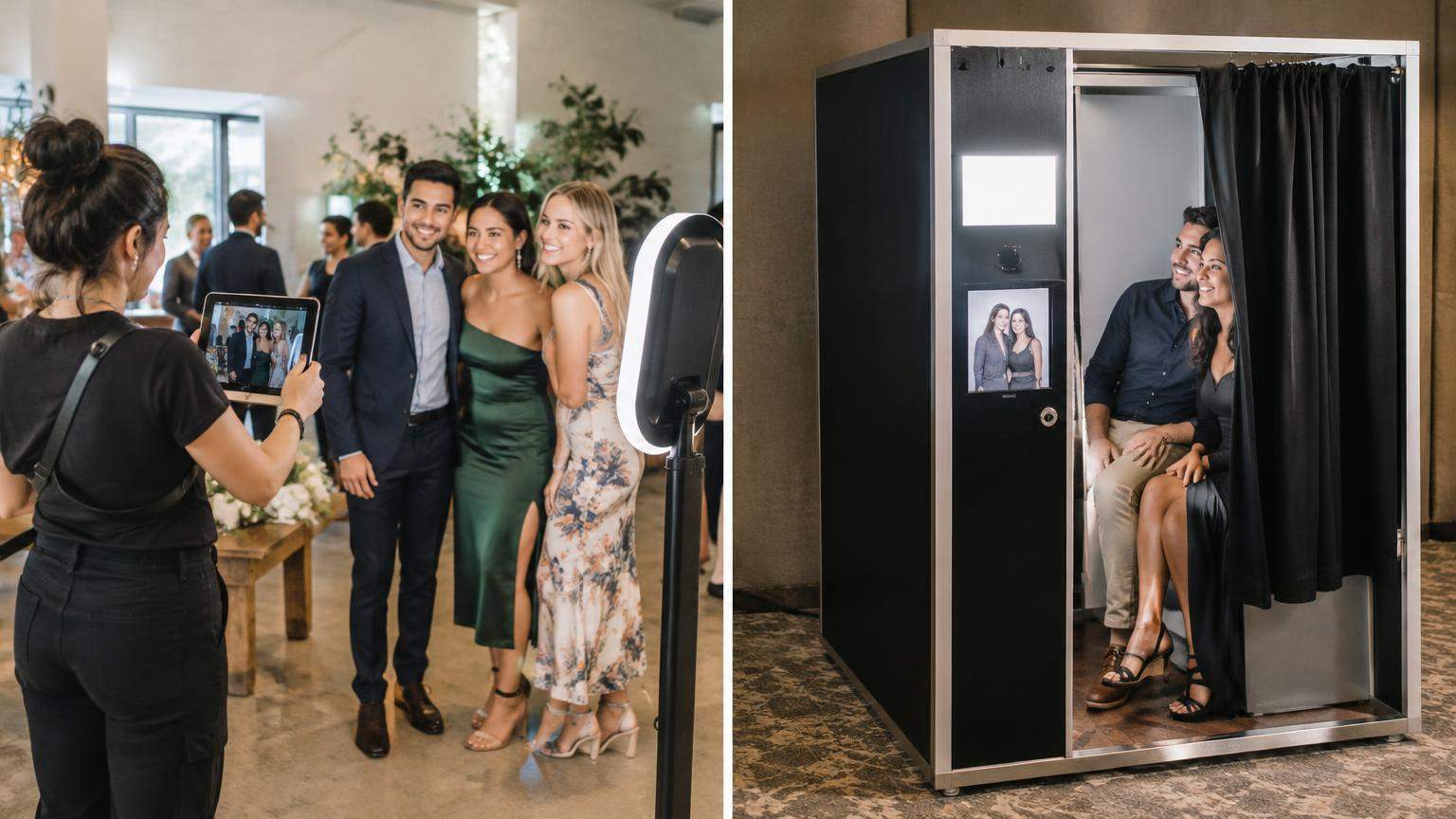
Before choosing sides, it helps to pin down what “roaming” and “traditional” actually mean in today’s event world.
A roaming photo booth (often called roaming photography or a mobile booth) is a compact, handheld system operated by an attendant who walks through the event capturing guests wherever they are. Operators such as MC2 Photo Booth describe a roaming booth as a completely mobile experience: the attendant carries a small screen with an integrated ring light and can photograph guests throughout the venue instead of at a single station. [1][2]
A traditional photo booth is a fixed installation that guests walk up to. There are two main styles:
- Enclosed booths – a sit‑in or stand‑in cabinet with a curtain or door. Guests step inside, the curtain closes, a short sequence of photos is taken automatically and prints are produced. Classic event booths closely follow the vintage vending‑machine booths described in reference articles and rental listings. [3][4][7]
- Open‑air booths – a camera (often DSLR) on a stand, with a studio flash or continuous light, plus a backdrop. Guests pose in front, trigger the countdown on a touch screen and receive instant prints. Vendors such as Ultra Photo Booth and Pixel Perfect Booths present this as their standard “traditional” setup, with professional lighting and branded prints. [5][6]
For this comparison, we will treat “traditional photo booth” as any fixed-position, print-capable booth (open‑air or enclosed), and “roaming booth” as an attendant-operated, battery-powered system that moves through the crowd and usually focuses on digital delivery. [1][3]
How Each Experience Works for Guests
Guest Journey in a Roaming Photo Booth
In a roaming setup, the booth comes to the guest.
- An attendant moves through priority zones – cocktail area, dance floor, VIP lounge, sponsor activations – with a tablet-sized screen and ring light or compact LED on a handle or harness. [1][2]
- They invite groups to pose, frame the shot, start a countdown and show guests a live preview.
- After the photo, guests enter a phone number, email address or scan a QR code to receive a digital copy, typically as a branded still, GIF or short boomerang-style clip. [1]
- Images are delivered via SMS, email or a web gallery, depending on the software and connectivity. Printing is sometimes available through a separate print station, but most roaming services are marketed as digital‑first. [1]
This experience feels more like event photography combined with instant social-sharing tools than like a classic kiosk.
Guest Journey in a Traditional Photo Booth
In a traditional booth, guests go to the booth.
- The booth is set up in a fixed location with a backdrop, lights, props and often a branded backdrop or wrap. [5][6]
- Guests queue, step into position (or inside the enclosure), tap a start button on the touch screen and follow an on-screen countdown through a series of poses. [3]
- Within seconds, the booth produces printed photo strips or 4×6 prints, usually with the couple’s names or event branding. Instant prints are a core promise in traditional booth marketing and guides. [3][5][8]
- Modern booths also offer digital copies via email, SMS or online galleries; these are an addition to – not a replacement for – the prints in most traditional packages. [5][8]
The fixed booth becomes a recognisable “mini attraction” in the room, with a clear line, predictable workflow and tangible keepsakes.
Feature-by-Feature Comparison
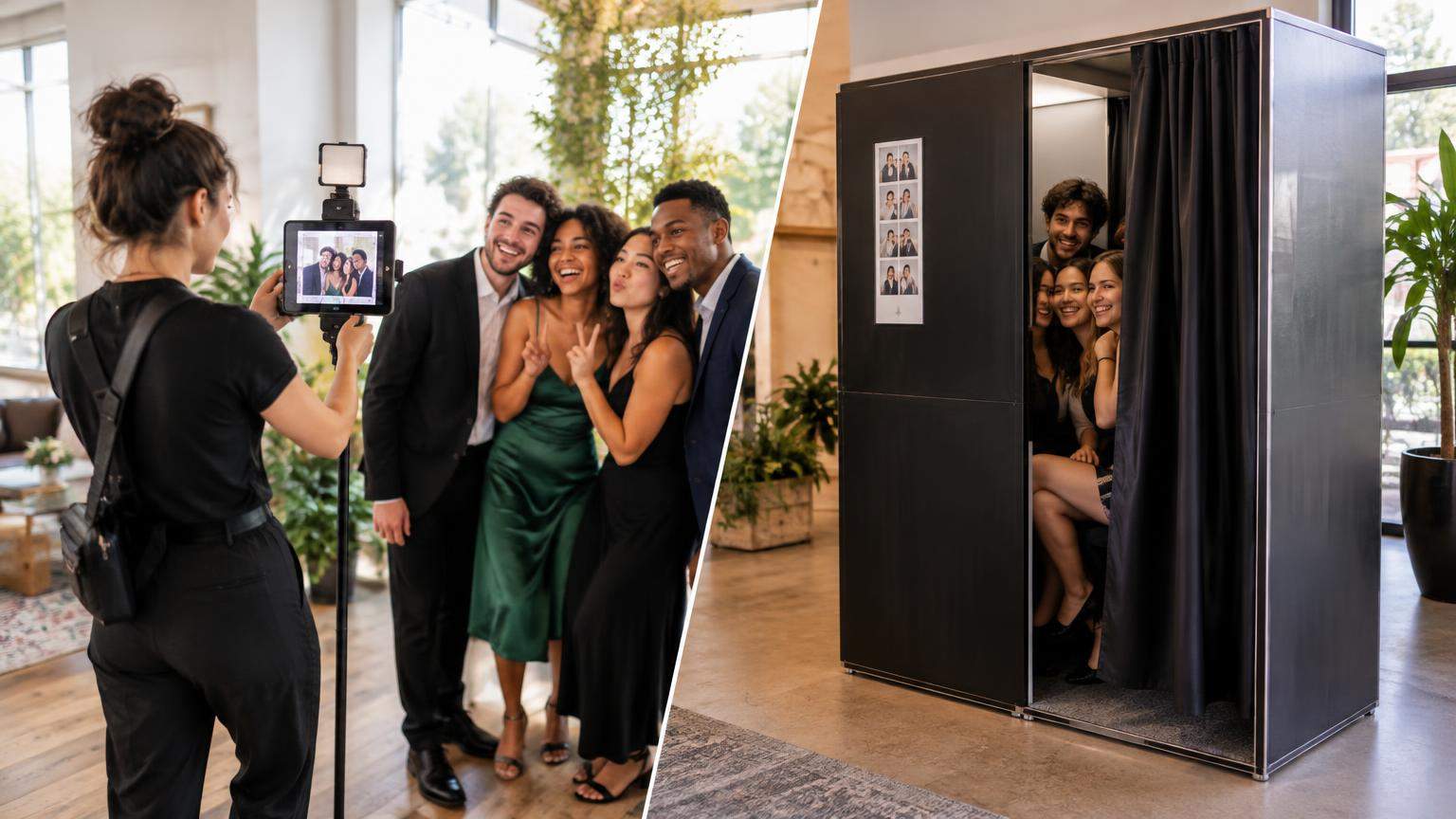
The table below summarises how roaming and traditional photo booths differ across the factors planners care about most.
| Feature | Roaming Photo Booth | Traditional Photo Booth (Open-Air or Enclosed) |
|---|---|---|
| Mobility | Fully mobile; attendant walks throughout the venue with handheld kit. Ideal for covering multiple rooms or large, spread-out spaces. [1][2] | Fixed in one location; guests must come to the booth. Can be repositioned between segments but not during use. [3][5] |
| Space requirements | Minimal footprint; only the attendant and small device. Useful where floor space is tight or layouts shift during the event. [1] | Requires defined area for backdrop, lights, props and queue. Open-air setups in particular need a reasonably large open space. [5][7][8] |
| Prints vs digital | Primarily digital delivery via SMS, email or QR; on-site printing is uncommon and often an optional add-on. [1] | Instant physical prints are a signature feature; many operators highlight unlimited photo strips or prints as a key selling point. [3][5][8] |
| Lighting consistency | Ring light or compact LED; quality can vary with ambient venue lighting and crowd movement. Best in reasonably lit spaces. [1] | Studio-style flash or continuous light with controlled framing; enclosed booths also block ambient light for very consistent results. [5][9] |
| Branding options | Branded digital overlays and microsites; pairs well with other branded installations or sponsor zones. [1][2] | Branded prints, backdrops, booth wraps and screens – every physical strip can carry logos, names and dates. Stronger visual presence in the room. [5][6][7] |
| Power | Generally battery-powered; avoids cables and power drops but depends on battery management. [1] | Requires mains power for camera, lighting and printers; planners must confirm outlet access and load. [5][8] |
| Connectivity | Often needs reliable Wi‑Fi or mobile data for live digital delivery; some systems can queue messages for later. (Check with your provider.) | Digital sharing also benefits from connectivity, but printing still works without internet if the booth is designed that way. [5] |
| Queue management | No formal line; attendant circulates and invites guests. Good for shy guests and crowded mingling areas, but coverage depends heavily on the operator’s route and initiative. [1][2] | Visible queue and clear turn‑taking. Easy to direct guests (“find the booth near the bar”), but some people may never approach it, especially during short segments like cocktail hour. [3] |
| Accessibility | Attendant can proactively approach guests who may not move easily through the venue and adjust angles for wheelchairs or bulky outfits. | Open-air booths can be set up for wheelchair access; enclosed booths may be tighter and require more careful placement. [4][9] |
| Operator skill reliance | Highly dependent on attendant personality and skill in approaching groups, composing shots and managing routes. | More systematised: once set up, the booth guides guests through the workflow with on-screen prompts. Attendant focuses on queue and props. [3][5] |
Use Cases: Where Each Booth Type Shines
Weddings and Family Celebrations
Traditional booth advantages
- Printed strips with the couple’s names and wedding date are still one of the most recognisable keepsakes guests expect from a photo booth. [3][5][8]
- Enclosed retro booths add a nostalgic, cinema-style feel that many couples choose precisely for their vintage look and sense of privacy. [4][7]
- Open-air traditional booths can be styled with custom backdrops and decor that match the wedding theme, becoming a design feature rather than just a piece of gear. [6][10]
Roaming booth advantages
- During cocktail hour, guests are often spread across terraces, foyers and lounges. A roaming setup can move through these areas and capture groups that would never make it to a remote booth before dinner. [1][2]
- On crowded dance floors, roaming attendants can capture high‑energy GIFs and boomerangs with the DJ, performers and dance circles in the background, something a fixed backdrop can never replicate. [1]
- Roaming works well for guests who avoid cameras; a friendly attendant can encourage quick, low‑pressure shots without the formality of walking to a booth corner.
Practical wedding strategy
For medium to large weddings, many planners now treat roaming and traditional as complementary rather than competing options:
- Use a roaming booth for cocktail hour and the first part of the reception, covering arrivals, decor and candid interactions.
- Anchor the after-dinner segment with a traditional booth that offers printed keepsakes and a clear activity guests can seek out between speeches and dancing. [1][2][5]
This hybrid approach also spreads demand: roaming handles early, fluid moments, while the fixed booth absorbs guests who want more deliberate portraits and physical prints.
Cocktail Hours and Networking Receptions
Roaming strength
Cocktail and networking formats are where roaming booths arguably offer the most distinctive value:
- Guests are usually standing, circulating and holding drinks – exactly the scenario roaming systems were designed for. Attendants can quickly join groups and create short, branded content without breaking conversations. [1][2]
- Event owners can brief roaming operators to focus on particular guests – VIPs, sponsors, speakers or award recipients – ensuring coverage of key people without formal photo calls.
- Because most roaming setups deliver digital images instantly, they support real-time social sharing or corporate follow‑up (e.g., links to event microsites or post‑event emails). [1]
Traditional strength
A fixed booth can still work well for networking, especially when you want:
- A recognisable, sponsor‑branded installation that draws people over during breaks. Operators of open-air booths often highlight fully branded backdrops, touch screens and print templates for this reason. [5][6]
- High-volume throughput in limited time windows (coffee breaks, evening drinks), with a predictable queue instead of relying on an attendant to find every group.
For conferences, trade shows and corporate receptions, roaming and traditional can again complement each other: roaming for floor coverage and spontaneous content, traditional for a consistent, sponsor-backed experience and reliable data capture.
Crowded Receptions and Tight Venues
Space and crowding considerations
- Open-air traditional booths provide plenty of room for big groups and dramatic backdrops, but they require a decent footprint and clear space in front for queues and props. Rental guides recommend confirming this space early in layout planning. [5][8]
- Enclosed booths are more compact and self-contained, so they can fit into corners or alcoves while still offering privacy. [4][9]
- Roaming systems avoid any permanent footprint on the floor, but attendants must still be able to move safely through the crowd and avoid blocking key traffic routes.
In especially tight restaurants, heritage venues or multi-level spaces, the choice may come down to whether you can give up a fixed 2×2 m area for several hours. If not, roaming offers a way to capture content without compromising fire exits or seating density.
Corporate Branding and Sponsorship
Traditional booth branding power
For brand-heavy events, traditional booths have two big advantages:
- They are physically large, so wraps, backdrops and screens can be fully branded with logos, campaign artwork and hashtags. [6][10]
- Every print that guests take home carries the brand or sponsor logo and message on a custom strip or 4×6 layout. Operators emphasise customised print designs in their service descriptions. [5][6][7]
If you want to create professional branded photo strips for weddings or corporate events, read our guide on how to design a custom photo template. It explains photo layouts, colours, logos and printing considerations.
Roaming branding options
Roaming activations support branding in more subtle but still useful ways:
- Digital overlays, frames and start screens can carry logos and messages that appear on every delivered file. [1][2]
- Attendants can be briefed to prioritise branded areas, such as sponsor photo walls, product displays or step‑and‑repeat banners.
- Because roaming content is usually digital‑first, it can be linked to trackable URLs or QR codes that lead guests to campaign landing pages.
For major sponsorships, many brands will expect a strong on-site physical presence plus measurable digital output. In those cases, a traditional booth or branded backdrop often forms the visual anchor, with roaming coverage added to reach guests who never pass that point.
Risks, Limitations and Trade-Offs
No format is perfect. Understanding where each booth type struggles will help you design around the weak spots.
Connectivity Dependence
Both roaming and modern traditional booths frequently offer real-time digital sharing via SMS and email. This depends on either Wi‑Fi or mobile data; if the venue has poor connectivity, delivery may be delayed until the system reconnects.
- Roaming systems are often digital‑only, so poor connectivity can mean guests leave expecting images that will arrive later. Ask your provider whether the software stores captures safely offline and sends them automatically once the connection is restored. [1]
- Traditional booths generally still print even if internet is down, as long as power remains – printing is handled by the booth and printer, not the network. [5]
For both formats, confirm in advance how offline queuing, retries and gallery access work, and include clear wording in your event comms if delivery might be delayed.
Power and Battery Management
- Traditional booths usually require at least one dedicated power outlet for the camera, computer, lighting and dye‑sublimation printer. Rental guides advise checking power availability and extension policies with venues, especially older properties. [5][8]
- Roaming booths avoid cables but rely on fully charged batteries for the device and light. If the operator mismanages charging or spares, image quality and uptime can suffer.
Ask vendors to explain their battery strategy (spares, swap procedures, charging points) and build short breaks into the run sheet for them to reset if needed.
Throughput and Coverage
- A busy fixed booth can move guests through very rapidly, because the workflow is standardised and guests self‑serve with simple prompts. [3][5]
- Roaming coverage is constrained by the number of attendants. One person can only be in one place at a time, so there is a trade‑off between spending more time per group and covering more of the room.
For large guest counts, consider either multiple roaming operators or a hybrid setup where a fixed booth handles high volume and roaming focuses on key areas.
Image Style and Control
- Traditional booths offer highly consistent lighting and framing. This is ideal if you need uniform portraits (e.g., for corporate headshots, step‑and‑repeat sequences or a guest book). [5][9]
- Roaming images are more varied: angles, lighting and backgrounds change constantly. This creates energy and authenticity but reduces uniformity, which may or may not suit campaign requirements.
Decision Guide: Matching Booth Type to Your Event
Use the prompts below to decide whether roaming, traditional or a hybrid will best serve your specific event.
If Your Priority Is… Tangible Keepsakes
Choose a traditional booth.
- Printed strips and photos are core to the traditional booth experience and are heavily emphasised by both guides and vendors. [3][5][8]
- Guests can pin prints on fridges, desks and walls – especially meaningful at weddings and milestone birthdays.
If Your Priority Is… Maximum Coverage of a Moving Crowd
Choose a roaming booth (or roaming plus a small fixed station).
- Roaming attendants can follow the flow of the crowd through foyers, networking nooks, terraces and crowded dance floors. [1][2]
- This is particularly useful for cocktail-style events with no assigned seating and minimal dwell time near a traditional booth.
If Your Priority Is… Strong Visual Branding On Site
Choose a traditional open-air booth with a custom backdrop, screen graphics and print design.
- Large backdrops and booth wraps make brand artwork visible even to guests who never use the booth. [6][10]
- Every print carries the logo or campaign hashtag, reinforcing recall after the event. [5][6][7]
You can layer in roaming coverage focused on branded environments or activations, but the fixed installation is what sponsors and corporate marketing teams typically look for first.
If Your Priority Is… Working Around Space Constraints
Consider a roaming booth or a compact enclosed booth.
- Roaming booths free you from committing floor space, which is helpful in tight bars, restaurants or heritage buildings with strict capacity limits. [1]
- Enclosed retro-style booths are self-contained and can sometimes slot into alcoves or recessed spaces, requiring less surrounding area than open-air setups. [4][7][9]
If you do use a traditional booth, plan layouts early and coordinate with your photo booth provider on space diagrams and power locations. Guides like Bay Area Event Services’ rental checklist underline the importance of confirming these basics before signing. [8]
If Your Priority Is… Ease of Operation for New Booth Owners
For new or part-time booth operators building a service, a traditional fixed booth often provides a more predictable starting point:
- The workflow is automated and consistent; once you have a reliable setup process, each event runs similarly. [3][5]
- Attendant tasks focus on guest flow, props and occasional technical checks rather than constant roaming, approaching and composing shots.
Roaming systems add value for experienced operators comfortable with crowd work and with clear staffing plans.
Operator Checklist: Questions to Answer Before You Commit
Whether you are an event planner hiring a vendor or a booth operator designing your packages, this checklist will help you make a grounded choice between roaming and traditional setups.
1. Technical and Venue Requirements
- What power is available? Confirm the number and position of outlets, maximum load per circuit and whether extension leads are permitted. Fixed booths with printers typically need at least one dedicated outlet. [5][8]
- How reliable is venue connectivity? Ask the venue about guest Wi‑Fi and mobile coverage. Then confirm with your booth provider how digital sharing works if connectivity drops.
- What are the space constraints? Request or draw a floor plan. For traditional booths, mark out the booth area, queue space and prop tables. For roaming, plan the operator’s route and safe paths through the crowd. [5][8]
- Is there a setup guide? If you are operating the booth yourself, follow a structured photo booth setup guide covering camera height, lighting angles, test shots and backup procedures.
2. Guest Experience and Deliverables
- Do you need prints, digital, or both? Clarify expectations with your client. Wedding couples may strongly prefer physical strips for guest books; corporate clients may care more about digital data capture and social sharing. [3][5][8]
- What branding elements are required? List logos, taglines, event names and colours that must appear on overlays, prints, microsites and backdrops. Traditional booths often give you more physical real estate to apply them. [5][6][7]
- Are there specific accessibility needs? Think about wheelchair users, older guests and guests in traditional or bulky outfits. Decide whether roaming access, open-air framing or a larger enclosure will serve them best. [4][9]
3. Staffing and Operations
- How many attendants do you have? One roaming attendant can cover a moderate event, but very large or multi-room venues may need two or more to avoid missing large sections of the crowd. Traditional booths may manage with a single operator monitoring the station. [1][2][5]
- What training do they have? Roaming attendants should be confident approaching guests and composing flattering images on the move. Traditional booth attendants should be trained in quick troubleshooting, print management and queue control.
- How will you handle peak times? Identify event peaks – post-ceremony, after speeches, pre-awards – and decide whether you need both roaming and fixed coverage during these windows.
4. Contingency Planning
- Backup power and batteries: For traditional booths, consider surge protection and spare cables; for roaming, ensure spare batteries or power banks are fully charged and accessible.
- Connectivity workarounds: Confirm offline operation, queued sending and post-event gallery access in writing with your provider.
- Equipment redundancy: Especially for corporate and large weddings, having a spare camera body, tablet or light can prevent a total shutdown if something fails mid-event. [5][8]
Frequently Asked Questions
Can a roaming photo booth print photos on site?
Some roaming services can be paired with a stationary print station, but roaming offerings from operators like MC2 Photo Booth are primarily marketed as digital experiences with instant SMS or email delivery rather than print-first services. [1] If printing is important, confirm explicitly whether on-site prints are included for roaming captures or only for images taken at a fixed booth.
Is a roaming photo booth enough for a large wedding or gala?
It can be, but capacity depends on guest count, event layout and duration. A single roaming operator might struggle to cover a multi-hundred-guest event spread across several rooms. Many planners therefore combine roaming with a traditional booth: roaming for candid coverage in circulation areas and a fixed station for guests who want more posed portraits and printed keepsakes. [1][2][5]
Which is better for corporate lead capture: roaming or traditional?
Both can collect contact details, but they excel differently. Traditional booths provide a clear station where guests expect to enter details for prints or digital copies, and every print becomes a branded reminder. [5][6] Roaming booths can reach more people in networking spaces and add QR codes or links to digital files, but they rely more on attendant prompts to capture complete data. The right choice depends on whether you prioritise structured lead capture at a fixed point or broad, informal coverage across the venue.
Are traditional booths old-fashioned compared with roaming systems?
Traditional booths have evolved considerably. Modern fixed booths typically use DSLR or high-quality cameras, touch screens, social-sharing software and custom overlays alongside instant prints. [5][6] Roaming systems are newer in concept, but both formats now leverage similar software ecosystems; the main difference is in how guests physically interact with them, not whether they are “modern” or “outdated.”
Can I run both a roaming and a traditional booth at the same event?
Yes. In fact, roaming providers such as Strata Booth explicitly encourage combining roaming photography with a fixed booth or other installations such as 360 or AI-based experiences. [2] This approach is particularly effective at large weddings, festivals and conferences where you want both a strong visual anchor and flexible coverage.
Disclaimer
This article provides general guidance about choosing between roaming and traditional photo booths based on commonly advertised features and typical event scenarios. Specific capabilities, technical requirements and performance vary significantly between providers and markets. Always review current specifications, contracts and venue rules, and confirm details such as power, connectivity, accessibility and deliverables directly with your chosen vendor before finalising event plans.
Sources and Further Reading
Primary and supporting references. Verify time-sensitive information at the original publisher.
- Roaming Photo Booth — www.mc2photobooth.com
- Roaming Event Photography — stratabooth.com
- Photo Booth — en.wikipedia.org
- Classic Photo Booth — cocoeventsnyc.com
- Traditional Booth — www.ultraphotobooth.com
- Open Air Photo Booth Rental Chicago Il — pixelperfectbooths.com
- Enclosed Retro Photo Booth — www.mc2photobooth.com
- Photo Booth Rental Guide What To Look For — bayareaeventservices.com
- Enclosed Photo Booth — urbnevents.com
- Open Booth — www.thephotobusdfw.com
Research date: October 18, 2026 (UTC). Links may change.